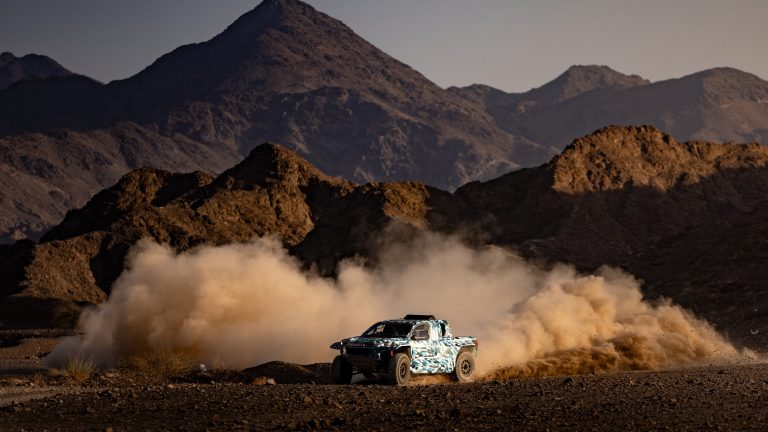
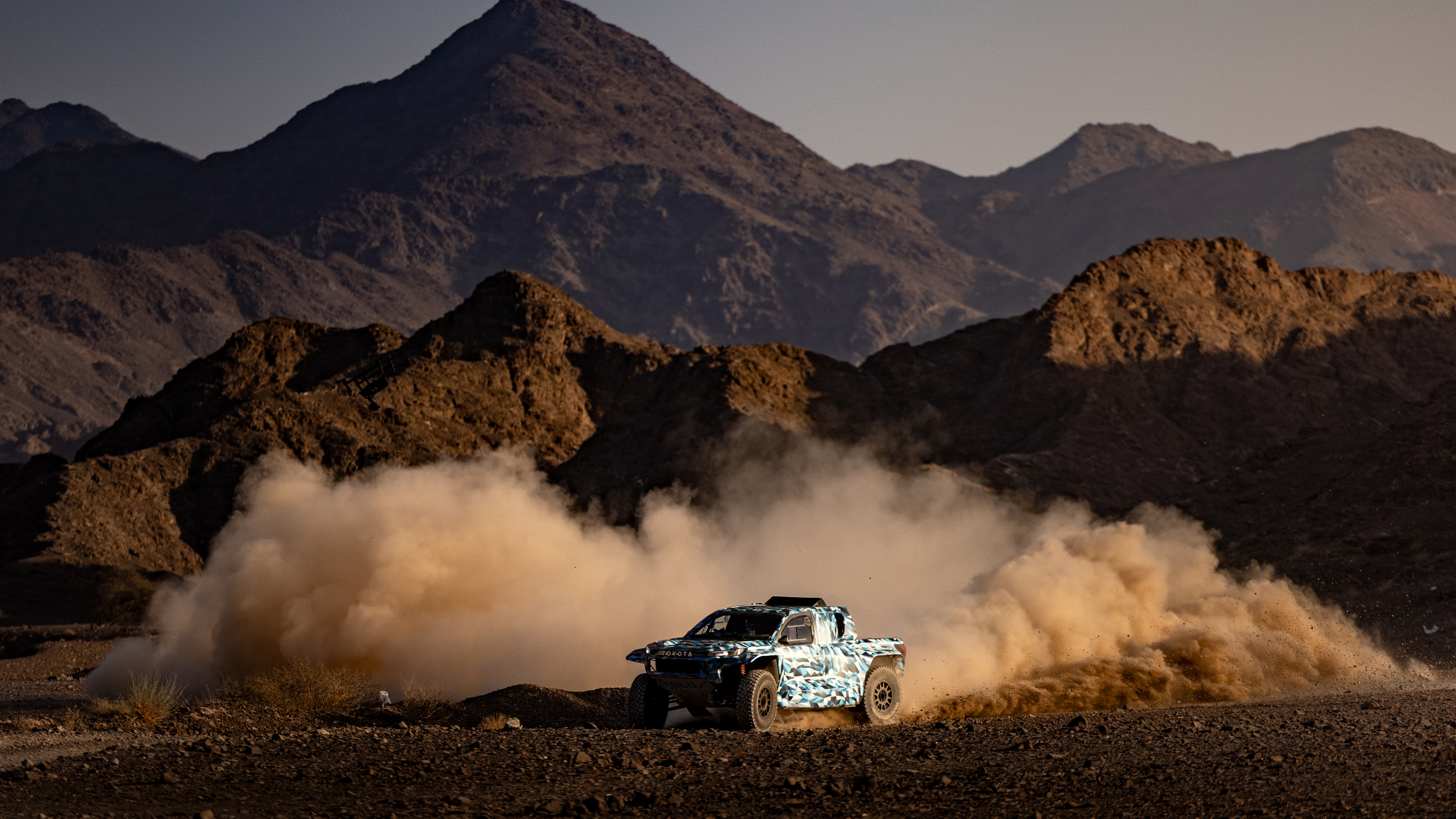
Gazoo Racing to advance fuel cell electric vehicle development with Hilux prototype Dakar Rally entry
- Gazoo Racing to enter fuel cell electric vehicle (FCEV) in the 2027 Dakar Rally
- DKR GR FC Hilux prototype, based on the DKR GR Hilux, will compete in the Dakar Future Mission 1000 category for experimental vehicles
- First application of Toyota’s fuel cell technology for motorsport
- In its commitment to making ever-better, motorsports-bred cars, Gazoo Racing aims to support the advancement of FCEV technology, focusing on fuel cell downsizing, improved cooling and durability
Toyota’s hydrogen fuel cell technology is being put to the test in one of the world’s most gruelling motorsport challenges. Gazoo Racing will enter the DKR GR FC Hilux, a new fuel cell electric vehicle (FCEV), in the 2027 Dakar Rally, a move that reflects Toyota’s commitment to making ever-better cars bred from motorsport.
The new DKR GR FC Hilux prototype is based on the DKR GR Hilux, which has already proved its strength and durability in the rally’s top category. That model’s petrol engine is replaced in the prototype by Toyota’s fuel cell system, which produces no CO2 when driven; the only tailpipe emission is water.
While Toyota has pioneered the development of hydrogen-engined race and rally cars, this is the first time its hydrogen fuel cell technology has been developed for motorsport.
The Dakar Rally’s hostile environment includes high temperatures, rough terrain and long-distance competitive stages, making it an ideal proving ground for fuel cell technology. To deliver high performance safely and reliably in these conditions, the project will focus on downsizing the fuel cell, optimising cooling, durability and energy management.
Lessons learned from developing and running the DKR GR FC Hilux will contribute to the wider application of fuel cell technology in passenger cars, trucks, buses, trains, marine applications, race cars and stationary power generators. Engineers involved in the project will also develop problem-solving skills through hands-on, on-site experience in a high-pressure environment.
Testing and tuning of the FCEV powertrain and its software, together with vehicle build-up, are under way in Belgium. A test programme will be rolled out in the coming months.
The 2027 Dakar Rally will take place in Saudi Arabia from 1 – 15 January, starting and finishing in the King Abdullah Economic City. The gruelling course pushes vehicles and drivers to their limits as it winds way through sand dunes, rocky unpaved roads and dry riverbeds. The DKR GR FC Hilux aims to prove the performance, safety and reliability of fuel cell technology, competing in the Dakar Future Mission 1000. Dedicated to experimental vehicles and the demonstration of new technologies, this rally category will see driver and navigator crews racing against the clock over 13 stages and a total of more than 620 competitive miles (1,000km).
Toyota hydrogen technology in motorsport
With its participation in the Dakar Future Mission 1000, Toyota takes another step in its work to achieve carbon neutrality in motorsport and expand the potential of hydrogen-related technologies. Its efforts began in 2021 when Rookie Racing entered the Japanese Super Taikyu endurance racing series with the hydrogen-engined ORC Rookie Corolla H2 Concept.
In rallying, the potential of hydrogen engines was shown by the GR Yaris H2 which completed demonstration runs at the 2022 Ypres Rally in Belgium, a round of the FIA World Rally Championship. Further development showcased by the GR Yaris Rally2 H2 Concept, which made demonstration appearances at Rally Finland in 2025 and Rallye Monte-Carlo in 2026.
Toyota Motor Corporation has also been involved with previous hydrogen-powered Dakar Rally entries through its participation with HySE, Hydrogen Small Mobility and Engine Technology Association. In 2024, the HySE-X1, a hydrogen-engined buggy, competed in the Dakar Future Mission 1,000, followed by the HySE-X2 in 2025.
Hydrogen’s potential in circuit racing is also being explored, with the Toyota Racing TR LH2 Racing Prototype driven on track in demonstration runs at this year’s Le Mans 24 Hours. Based on the TR010 Hybrid race car, it is powered by a liquid hydrogen engine. In Japan, a hydrogen-engined GR Corolla equipped with superconducting technology became the first vehicle of its kind in the world to complete a race, in the 2026 Super Taikyu series.
ENDS