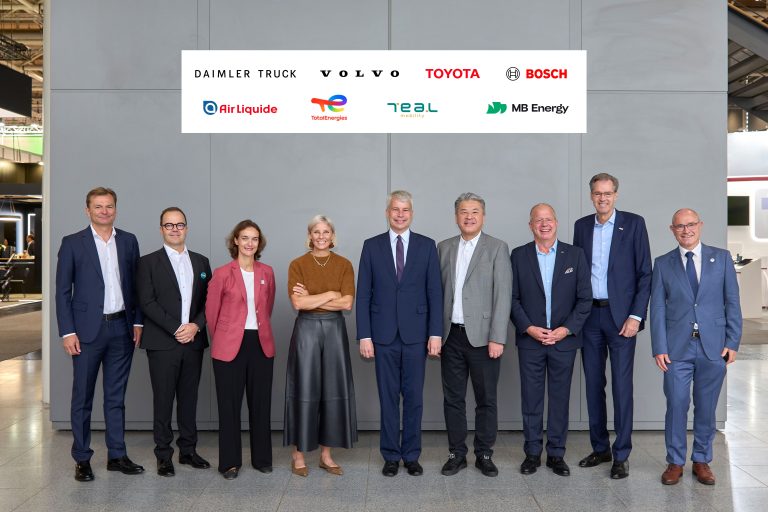
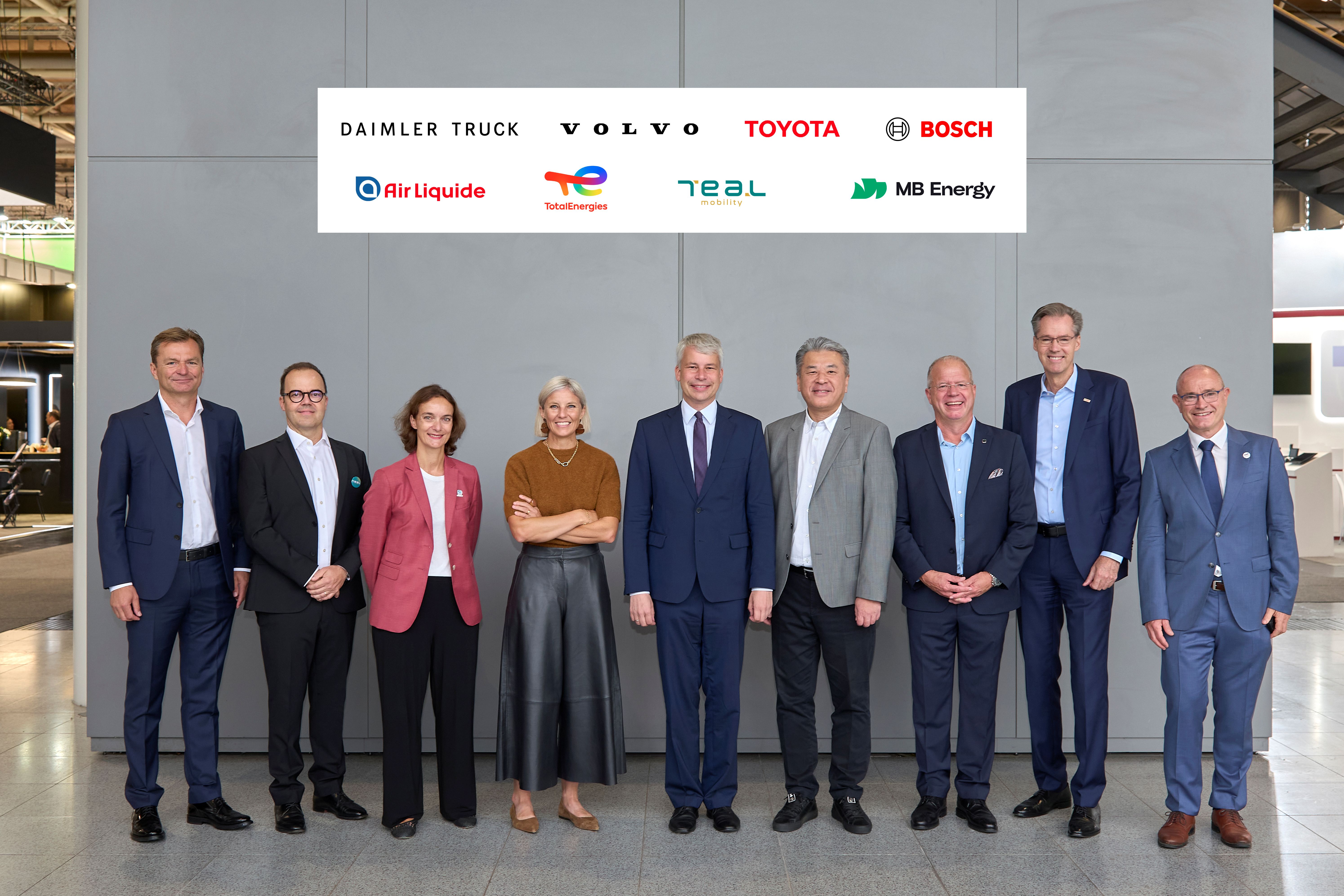
Industry leaders scale full value chain for hydrogen mobility across Europe
Today at IAA Transportation in Hannover, Germany, Volvo Group, Daimler Truck, Toyota Motor Corporation, Bosch, Air Liquide, TotalEnergies, TEAL Mobility and MB Energy unveiled their plans to accelerate the rollout of hydrogen-powered vehicles across Europe.
For the first time in Europe, the German ecosystem has put in place all the conditions for a scalable deployment of Hydrogen trucks by 2030, driven by the German authorities and European industrial leaders along the value chain. Building on the German deployment model as a practical baseline, scaling these solutions across the continent calls for aligned support from national governments and the European Commission to ensure long-term energy resilience and competitiveness.
Rooted in the shared conviction that hydrogen is an important complement to battery-electric vehicles in achieving the EU’s decarbonisation targets, industry leaders are joining forces to overcome historical bottlenecks, particularly for truck operations requiring long range, high payload capacity, rapid refueling and operational flexibility. At Daimler Truck, customers have driven almost 600,000 kilometres (373,000 miles) with fuel cell trucks. As the next step, the company plans to deploy a small series of 100 next generation fuel cell trucks into customer operations from the end of 2026 onwards. In parallel, the first hydrogen combustion engine trucks are being prepared for market launch next year. Overall, the company is investing a mid-three-digit million-euro amount in hydrogen trucks by the end of the decade.
Volvo Group is similarly advancing its hydrogen portfolio and investing significant amounts into hydrogen power solutions such as both fuel cell and hydrogen combustion trucks for market rollout towards 2030.
Toyota will participate as a technology partner supporting the expansion of hydrogen mobility, leveraging more than 30 years of expertise gained through the development and supply of fuel cell systems, while Bosch is supplying key vehicle components for gaseous hydrogen – with its fuel cell system proven over more than 30 million kilometres (18.6 million miles) on the road – alongside breakthrough refuelling technologies for both liquid and gaseous hydrogen.
On the energy and infrastructure side, Volvo Group and Daimler Truck are cooperating closely with energy companies and hydrogen suppliers such as Air Liquide, TotalEnergies and MB Energy, and retail operators such as MB Energy and TEAL Mobility (a 50/50 joint venture between TotalEnergies and Air Liquide, operating under the TotalEnergies brand). These players are mobilising their respective capacities to scale both liquid and gaseous hydrogen supply chains. Through their infrastructure investments, they are advancing toward large capacity, high-throughput refuelling stations that can refuel up to 100 trucks per day. They are also leveraging synergies with the fast-growing industrial renewable hydrogen production, driven by the implementation of the European RED III directive. Reaching competitive cost with diesel is essential for fleet operators’ adoption of hydrogen. Crucially, combining German government policies with industrial collaboration makes this possible through three key levers:
- Lowering truck cost through incentives and series production.
- Reaching a diesel-competitive hydrogen pump price through a more competitive hydrogen supply chain and Greenhouse Gas quota mechanisms.
- Offering operating incentives such as zero emission toll exemptions for fleet operators.
The market is rising to meet these conditions. Recent applications under Germany’s NOW funding programme were oversubscribed, with industrial companies applying for more than 70 high-capacity stations and 800 heavy-duty trucks, confirming strong commercial pull from the logistics sector.
While Germany serves as the operational launchpad, demonstrating how industry action and targeted public support can accelerate market development, the industry leaders are calling for strategic measures – supported by national governments and the European Commission – to replicate this model at a continental scale.
These measures include scaling infrastructure through synchronised funding calls for refuelling stations and vehicles to meet Alternative Fuels Infrastructure Regulation (AFIR) targets; strengthening the commercial viability of hydrogen through pragmatic, harmonised renewable fuel credit mechanisms and toll incentives; and jointly de-risking the overall value chain, from production and liquefaction to final distribution and vehicle operation.
This combination of industrial execution and a strong policy framework provide the foundation needed to scale zero-emission freight while reinforcing Europe’s industrial competitiveness, energy resilience and employment, and reducing emissions from freight transport.
ENDS